
Soft Launch of Transformation Institute!

Hi friends,

I’m beginning the “soft launch” of something that has grown out of my work in Japan over the last several years.  The Transformation Institute:  Community, Business and Personal Transformation is coming to life at web address Robert Theobald and I used for our work from the mid-nineties until his death just before the beginning of the new century.  Seems very fitting and appropriate.

Frankly, I don’t know exactly what the Transformation Institute is.  I just know it wants to be born.  Several questions contribute to its formation:

  • We will encounter more and more collapse of existing systems in the coming years.  How use collapse (disaster/emergency/revolt) as a springboard to transform our communities and our lives into ones which are healthy, resilient and thriving?  A friend in Japan made a critical observation last April, speaking of the triple disasters in Japan.  She said “we caused this.”  Three simple words.  They make us face the fact that while a natural disaster occurred, it was precipitated by an array of human choices.  Many of our choices will lead to more collapses.  Will we try to reconstruct the old normal, or can we learn how to use the energy of collapse to transform to a new more desirable state?
  • While there are differences in our community, business and personal lives, transformation of the three is interwoven.  How will we reconceptualize and recreate the relationship between these three aspects of our lives? One of my biggest lessons in Japan has been seeing what it looks like when business is still a part of community rather than apart from community.  I’m not trying to glamorize business in Japan or say there are not issues and problems, but what’s been striking to me are the ways in which community and social needs trump financial profit.  CSR isn’t enough, it feels kind of like an “oh, and, by the way, I wonder if there is something good we ought to be doing.”  What would it be like for community, business and personal to conceive of themselves as integral parts of a greater, related whole?
  • There is a great, latent potential for great cooperation and greater learning linking the whole of the Pacific Rim.  We are an ecology together.  How might the diverse insights, questions, knowledge and experience of countries, cultures and peoples on the Pacific Rim be invited into a deeper co-creative relationship?  How do we honor the particular problems and potential present in each context and learn together a we work to create a future that works for all?
  • Finally, the emergence of a new Tohoku Region in Japan will be a teacher to all of us.  How do we learn with and from the people of Japan as this beautiful Tohoku region comes back to life? What can those of us elsewhere around the rim contribute as people in Tohoku learn how to work together to create the communities, businesses and lives they want?  I remember the feeling in early April when I was co-hosting a group of 40 or so business leaders in Japan.  We began with grief, sadness and confusion that turned into excitement within three hours.  The shift was remarkable.  When I sensed into the shift these words came back to me:  we’ve been released from a future we did not want!  How can Japan lead the way in transformation?

It’s an exciting time.  Much is possible.  I invite you to help me think about how the new Transformation Institute might contribute to the possibilities which surround us!

Cheers,

Bob

Share

So What Are Future Centers??

In 2011 there the earth was shaking in many places.  Revolutions in Egypt and Libya, earthquakes in New Zealand, floods in Australia, Greeks occupying Syntagma Square, the US Occupy Movement, and of course the triple disasters of Japan.  This isn’t an exhaustive list, but it gives a view of a world shaking.  Various terms can be used to describe what’s happening.  Call it disaster or an emergency, or a revolution –  above all, call it a systems shift and call it connected.  The ways in which we’ve lived on this planet with our patterns of consumption, disregard for ecological systems, fear and greed just aren’t working out all that well.

Whenever a systems shift happens there’s a systems pull to get things back to the old normal.  Increasingly, however, more and more people see the old normal as undesirable. So the question becomes, how do we create something new when systems have started to shift?

In Japan we think that part of the answer to this question is by creating a visible Future Centers Network where people are working together to create the future they want.  This network will:

  • Connect existing as well as new work going on in all sectors — community, business, nonprofit and government.
  • Maximize diversity of perspective, opinion, approach and knowledge knowing that this leads to better possibilities
  • Share an evolving body of principles and practices as people discover better and better ways to come together to create their future, now.
  • Create a common language around the stages, steps and methodologies which support collaborative action.
  • Help people learn how to be Directors, Hosts and Harvesters from Future Centers.
  • Connect local learning from each Future Center into the network for collective learning.

It looks a little like this:

Get a sense of a lot of connections?  That’s exactly what we’re looking for.  Separate Future Centers are capable of doing extraordinary work.  When we connect these Future Centers with each other and weave them into an ecology of action, we are planting the seeds of transformation.

But you might ask, what is a Future Center, itself

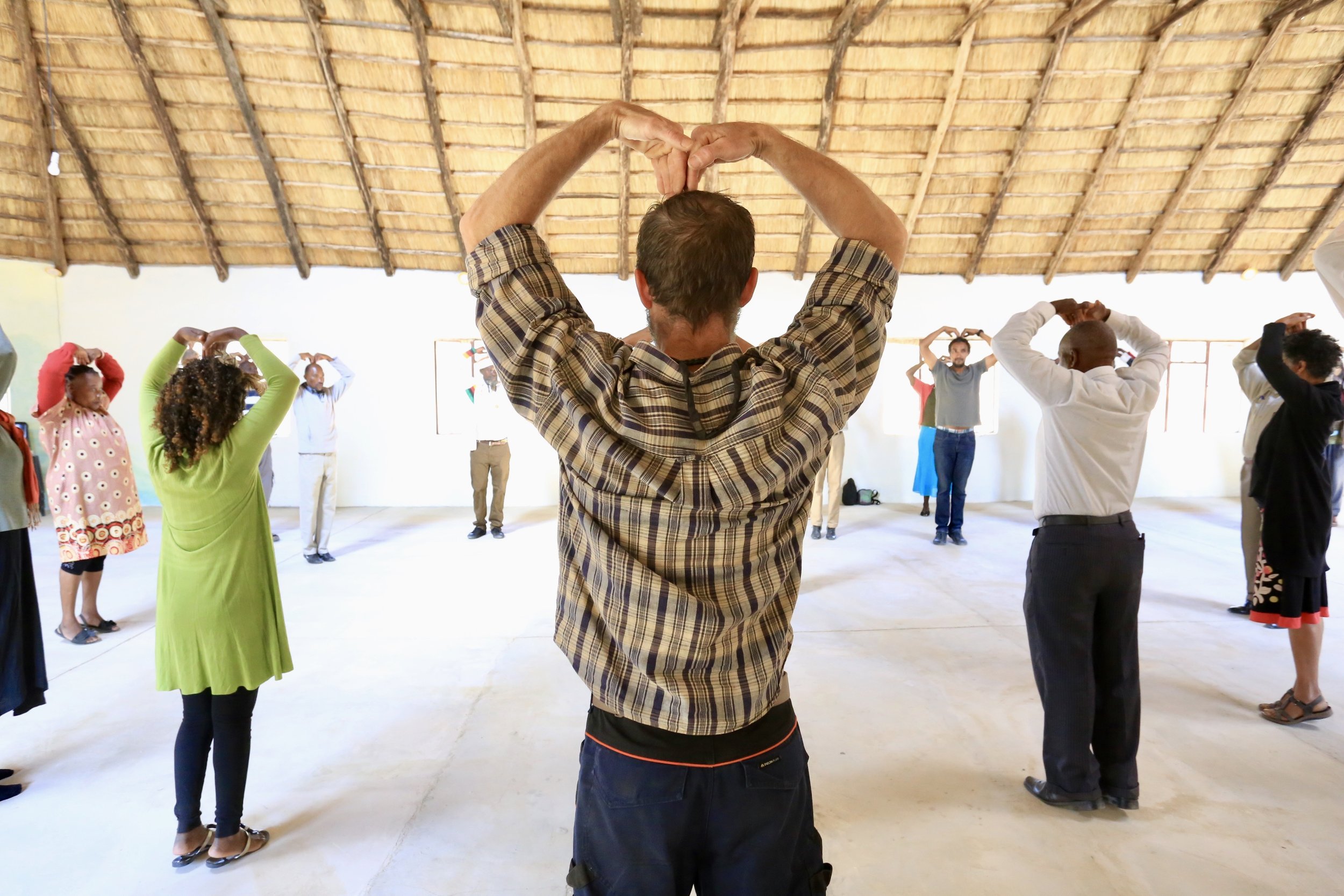
In Japan we say a Future Center is a BA for collaborative action.  BA is a classical Japanese term which refers to the space between us connecting us.  Simply put, Future Centers consist of one or more Future Center Sessions called for a particular purpose with an immediate focus and held in a hospitable BA which invites trust, relationship and creativity.  They are created by a design team,  hosted by facilitators and bring together people of any community — a geographic area, a community concerned about a particular issue, the community of a particular business — to share their questions, knowledge and expertise to create collaborative action.

Actually, as human beings, we’ve been doing this for ages.  When there is a problem or an opportunity, we come together and council with each other about how to best proceed.  We’ve forgotten some of this as we’ve given over more and more of our personal authority to institutions and government.  Across the world people are remembering that we must step forward together in support of what we want to happen. When we step forward with curiosity, respect and friendship, it is possible to create new actions which grow from the collective insight and collective will of communities.   Future Center simply gives a name, form and some useful methodologies to what communities have been doing since the beginning of time.

I’ve been working closely for the last two years with KDI (Knowledge Dynamics Initiative) of Fuji/Xerox in Tokyo to understand how Future Centers can support business innovation in Japan.  With their permission I am going to share two documents I’ve written based on many hours of dialoge with KDI staff, especially Nomura Takahiko-san, as well as others in the Japan business community.  While these are written from a business perspective, we believe the ideas are equally applicable in communities, with NPO work, while addressing particular issues and other settings.

These are still in draft form, so please do not circulate.  I offer them for your own understanding of what we are coming to understand about Future Centers in Japan.

Future Center Summary (7 pages)

Future Center Guide (43 pages)

Best,

Bob Stilger

Share

Seeding a network of 1000 Future Centers in Japan!

Wow,

I’ve been back in Japan for a quick visit.  When I left in mid-December, my intuition was that I should come back for a quick visit to begin the new year.  I wanted to know what the energy would be of the new year.

Incredible, overwhelming, stupendous. Those are a few of the words that come to mind.  Yesterday, on one of the coldest days in Tokyo this year 120 people showed up for a day long workshop on creating a network of social issue future centers.  We scheduled the workshop in early December and thought that perhaps 30 or so people would come.  Towards the end of the month, my dear friend and colleague Nomura-san from Fuji/Xerox’s KDI realizedt he would dedicate himself to launching a new Nonprofit Organization this year which would grow a network of social issue future centers. Miratsuku, the NPO founded last year by our dialog colleague Yuya Nishimura (http://emerging-future.org/), will incubate this network.

We started with stories.  I talked about different community work in Tohoku which was Future Center work — it just didn’t carry the name.  Nomura-san talked about the principles and practices of Future Centers that we’ve been articulating over the last year.  Then four different people talked about the work they were already doing which could easily be called Future Center work. When we planned this workshop we were using last year’s language of a network of 500 Future Centers.  But I saw immediately that was too few.  The energy in the room was for at least 1000!

I talked about the reasons we can plan on finding, creating and connecting 1000 Future Centers in Japan when then are only ten or so in Europe.  In Europe, a Future Center is a building.  In Japan a Future Center is a BA — a hospitable space which hosts the energy, dreams and possibilities or a group of people who come together to get something done.  And the energy in Japan is astounding right now.   3.11 has been the cause of great destruction, devastation and grief AND it has also sparked a sense of release from a future we did not want.  What’s happening — all over the place — is that people are stepping forward to take responsibility for their own lives.  It’s what we saw in the four presentations — one on TEDxTokyo which was one of the first TEDx programs in the world and which continues to morph into a more and more activities, one on Hana Lab which works to empower college aged women, one of a major insurance company that has embraced Future Centers as a way to get their work done, and one on an extensive community involvement program in Kyoto.  In each case what they’re doing is releasing energy and co-inspiring each other.

When I first arrived in Japan in 1970, one of the first phrases I encountered for describing Japan was “the nail that sticks up gets pounded down.”  This was one aspect of collective culture — people did not individuate.  They did not stand up for what they wanted.  Well, what’s happening now is that the same collective culture is becoming a force to help all nails stand up!  And this is a powerful shift.

So this work is already happening.  Why are Future Centers needed?

At The Berkana Institute we’ve talked for years about the power of a four stage process:  Name, Connect, Nourish and Illuminate.  Naming gives power.  It makes something going on visible.  Connecting begins to build a system of action which serves to increase the power:  we inspire each other.  Nourishing people doing Future Center work with explicit principles, practices, methodologies and resource materials make it possible to do even better work.  Illuminating the work already being done tells powerful stories which inspire and inform others.  We believe that by consciously creating a wide network of Future Centers it will be possible for more and more people to step into creating Japan’s future.

And the time is now.  There’s a readiness.  An eagerness to get to work.  In April of last year when I arrived three weeks after the disasters, the main emotional tone was grief and trauma; something else was stirring, a sense of the future being now — but grief was what was most present.  In August the mood was one of “it’s time to do something, but we don’t know what to do.”  By the end of the year there was another shift — a quiet determination that was beginning to quicken.

And now it is time.  If we had held yesterday’s workshop in early December, we probably would have had 30 or so people.  They would have been getting ready — but I doubt the spirit and determination we saw yesterday would have been present.  Professors, students, business people, NPO leaders, government officials, men and women. Youngest around 20 and oldest around 70.

The second half of the workshop was people talking about what they would contribute to build this network of 1000 social issue future centers.  We announced Future Center week for 2012 for the end of May.  Last year we made an all out effort to have 5 future center sessions in one week.  This year we want to have 100!

We’re getting traction.  This work is going to have to be nurtured and supported.  We’re going to learn our way into it.

The Future is Now.

Blessings,

Bob

Share
Follow me